

From the HISA Media Team:
HISA Publishes 2025 Third Quarter Metrics Report
December 4, 2025 (Lexington, KY) – The Horseracing Integrity and Safety Authority (HISA) today released its Third Quarter Metrics Report for 2025. The report provides detailed data on key safety metrics under HISA’s Racetrack Safety Program, including racing-related and training-related equine fatalities, riding crop rule violations and scratches.
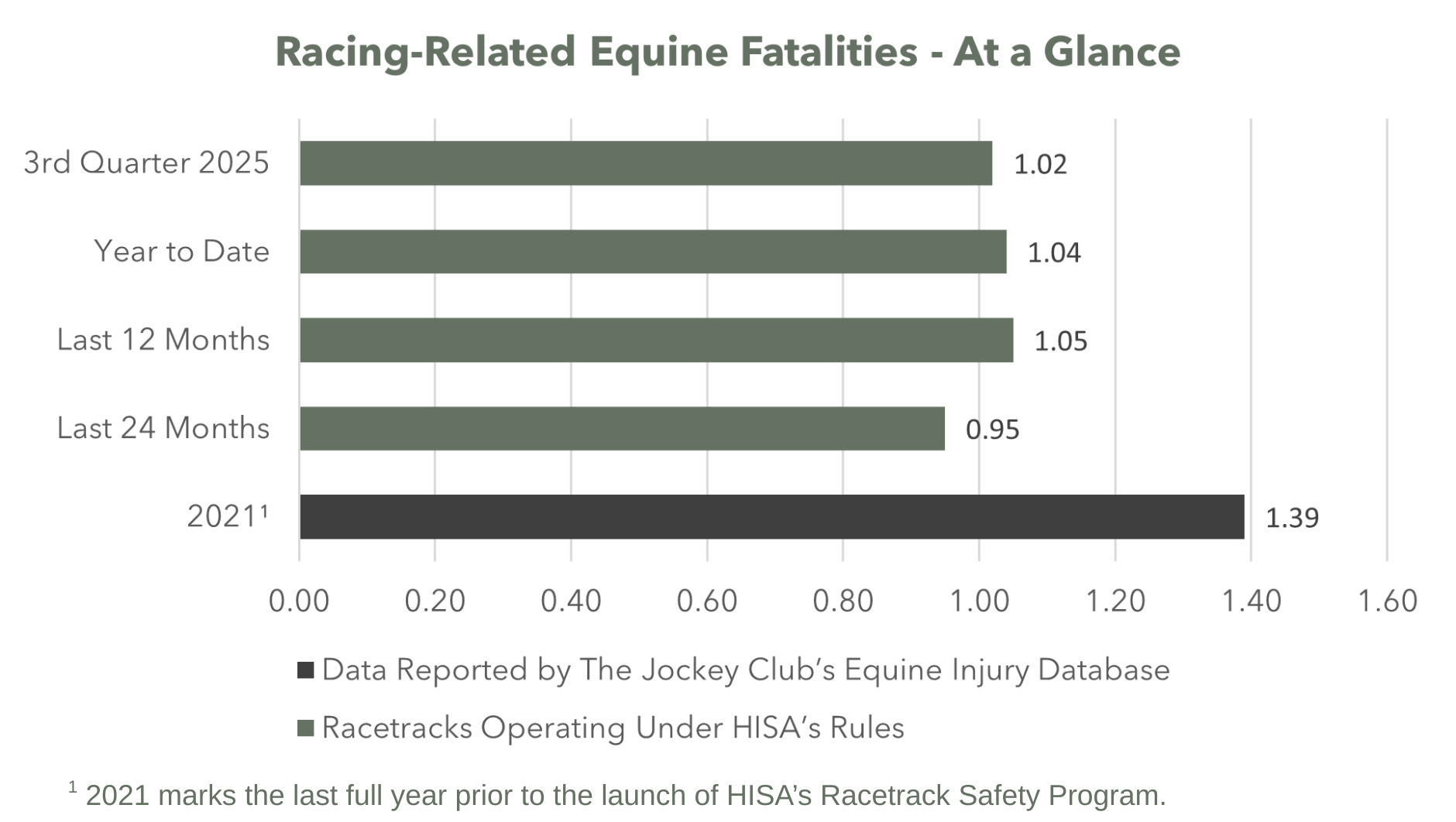
Racetracks operating under HISA’s rules continue to report roughly 1.0 fatalities per 1,000 starts across all benchmarks—marking a significant achievement in equine safety. In the third quarter, the racing-related equine fatality rate was 1.02 fatalities per 1,000 starts. This means 99.90% of Thoroughbred racehorse starts occurred without a fatality within 72 hours of racing due to race-related injuries. Over the past 24 months, the racing-related fatality rate remains unprecedentedly low at 0.95 fatalities per 1,000 starts.
In our third quarter of tracking training-related fatalities, we have seen a 10% year-over-year decrease. This quarter, training-related fatalities dropped to 0.38 deaths per 1,000 workouts from 0.42 in the same period last year. The third quarter rate is also 24% lower than the 2024 calendar-year rate (0.50). HISA’s training-related fatality metric captures horses that die or are euthanized within 72 hours of training as a result of injuries sustained during training.
“We are proud that HISA continues to chart the path forward for Thoroughbred racing in the United States,” said HISA CEO Lisa Lazarus. “No matter how you slice it—year-to-date, 12 months or 24 months—the racing-related fatality rate continues to hover around 1.0 per 1,000 starts, a benchmark previously thought unreachable. That said, we still have work to do and are actively collaborating with veterinarians, racetracks and trainers to understand why fatalities occur and implement best practices to prevent future incidents.”
Among the 29 racetracks open for racing in the third quarter, 12 improved their year-over-year racing-related fatality rates, and three racetracks—Santa Anita Park, Timonium and Aqueduct—reported zero fatalities for the second consecutive third quarter.
At the track-specific level, HISA completed an analysis of racing-related and training-related fatalities at Saratoga Race Course in 2025, compared to other horses in the same races or workouts as the deceased horses, revealing that horses that sustained fatal injuries had significantly higher rates of high-speed exercise in the six to ten months preceding the fatal event. Accordingly, the report underscores the importance of monitoring the behavior, performance and soundness of horses participating in intense high-speed exercise—and of adjusting training and racing intensity to mitigate injury risk.
As set forth in the report, use of riding crop violations also continued to decline. Violations decreased approximately 39% year over year, from 4.79 to 2.93 violations per 1,000 starts. In addition, HISA racetracks recorded an average 14.7% scratch rate per entry, roughly consistent with the 2024 third quarter rate of 14.8%.
The full Third Quarter Metrics Report is available on the HISA website. The Horseracing Integrity & Welfare Unit will publish a separate quarterly metrics report on the Anti-Doping and Medication Control Program later this month.
About the Horseracing Integrity and Safety Authority
When the Horseracing Integrity and Safety Act was signed into federal law, it charged the Horseracing Integrity and Safety Authority (HISA) with proposing and enforcing uniform safety and integrity rules in Thoroughbred racing in the United States. Overseen by the Federal Trade Commission (FTC), HISA is implementing, for the first time, a uniform national set of rules applicable to every Thoroughbred racing participant and racetrack facility. HISA has two programs: the Racetrack Safety Program, which went into effect on July 1, 2022, and the Anti-Doping and Medication Control (ADMC) Program, which went into effect on May 22, 2023.
The Racetrack Safety Program includes operational safety rules and national racetrack accreditation standards that seek to enhance equine welfare and minimize equine and jockey injury. The Program expands veterinary oversight, imposes surface maintenance and testing requirements, enhances jockey safety, regulates riding crop use and implements voided claim rules, among other important measures.
The ADMC Program includes a centralized testing and results management process and applies uniform penalties for violations efficiently and consistently across the United States. These rules and enforcement mechanisms are initially administered by an independent body, the Horseracing Integrity and Welfare Unit (HIWU), established by Drug Free Sport International (DFS). HIWU oversees testing, educates stakeholders on the Program, accredits laboratories, investigates potential ADMC violations and penalizes any such violations, subject to the FTC’s plenary review.





Leave A Comment
You must be logged in to post a comment.