
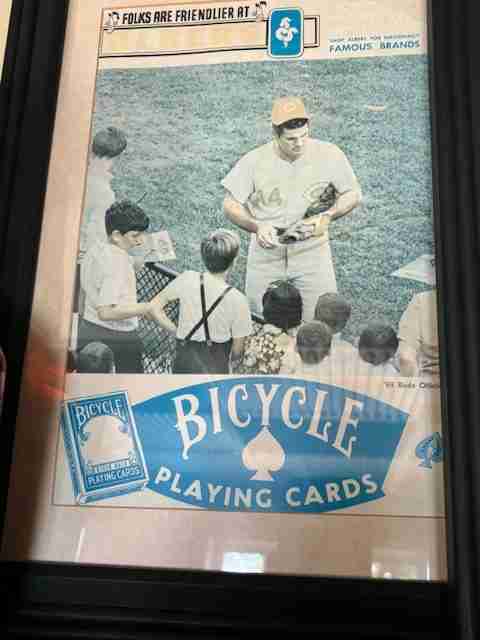
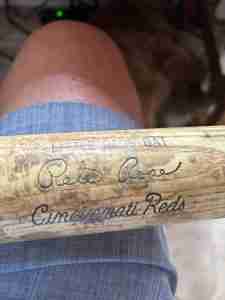
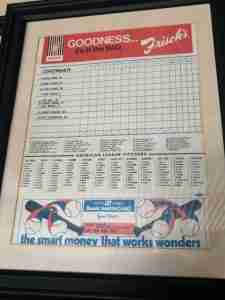
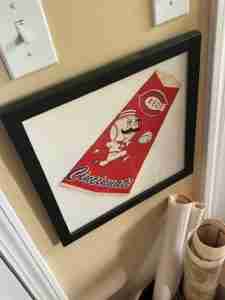
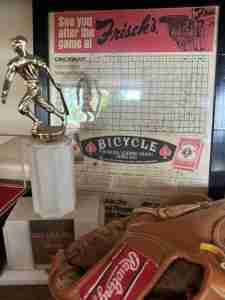
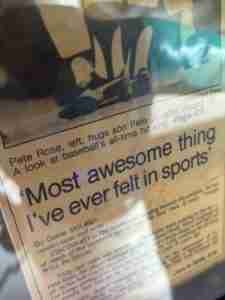
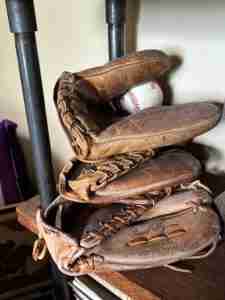
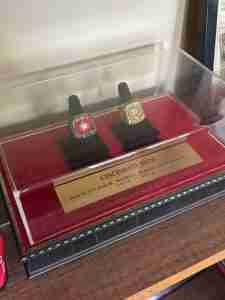
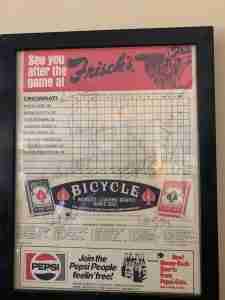
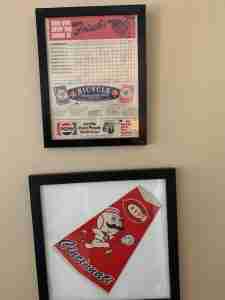
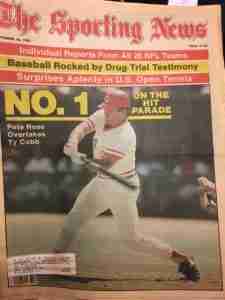
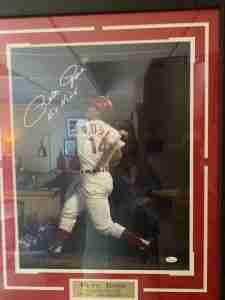
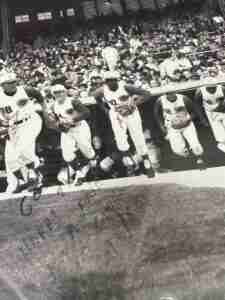
(My Pete Rose memories are always on display in my office)
I was a mere 7 years old back in 1963, when my mom and dad loaded my sister in me in our rustic Ford car — which had more rust and miles on it than it did future lifespan — and headed to Cincinnati for my first, ever, life-changing major league baseball game.
There wasn’t an I-75 back in those days. Just a little, winding, circling, bumpy road known as US 27. And, about every 10 miles or so that we trekked our way North, my dad had to pull the car to the side of the road and my mom had to jump out and hold my head in her hands. Car sick. And, I covered more of US 27 than the asphalt did that day.
But we were not to be detoured or deterred. When it came to plans to go to a baseball game, it didn’t matter what stood or piled up in our way. We were going to a baseball game. My dad was made that way.
And, as things turned out, while this was a journey that took a lot out of the day, and a lot out of me and the FAM…well…it also turned out to be the start of a journey of a lifetime. My life, in many ways, was forged that day. My life’s road was mapped that very day.
When we finally arrived in Cincinnati, I can still remember driving through the streets and seeing buildings that looked like mountains and more people than I had numbered in all of my previous 5 years. I hung out the window of the car and took it all in. There weren’t seat belts in those days, not that they could have made one to harness my active ass, any way. They didn’t make air conditioning either, and I was sweating bullets and spraying man-made water all over the other occupants.
Then, I saw the most magnificent structure I had ever seen, and one I would come to love and cherish as much as life itself — old, historic, white and magnificent Crosley Field. The home of the Cincinnati Reds. The home of the oldest major league baseball team in history. My “home” away from home.
The sights, sounds and smells overwhelmed me, as we made our way to the ballpark. The peanuts were roasting right there. The tall African-American gent who blew up 2-story high balloons and hawked them to kids like me was laughing and talking at the same time like he was the ringmaster of a circus parade. There were kids selling game programs. And, I had to have one of those programs and a Reds yearbook. Had to have. Even though money was hard to come by for our family, my dad found a way on this day.
Little did I know, though, that all of this glamour slapping me in the face like I was a dog riding down the road with my head out the window and my ears flapping in the swoosh of the ride, all of it would soon fade. And, it would pale. As soon as we we walked up that ramp and walked out towards our seats and I saw that field for the first time?
OMG.
The greenest grass in the entire free world was staring right back at me.
The brown dirt of the infield shined like a new copper penny.
The outfield fence was decorated with advertisements for Cincinnati’s own Bavarian beers.
The manually operated scoreboard stood like a church steeple in center field.
The bleacher seats were filling up in right field.
The grounds crew were mowing the “terrace” hill in left field and marking the white chalk lines behind home plate and down towards first and third base.
The Reds’ players strolled from the clubhouse, that was located behind the stadium, through the first floor seats and to the field and the dugout. I got to shake a few hands of the most impressive-looking athletes I had ever laid eyes on in my life. A few players were playing “pepper” near home plate and a few others were warming up by tossing a ball back and forth by the bullpens located down the left- and right-field lines.
And, then, all of a sudden, I saw the Cincinnati Reds’ starting lineup take Crosley Field with a rush in those white uniforms with the player names sewn into their jerseys underneath the numbers. There was #20 — Frank Robinson. There was #28 — Vada Pinson. There was #17 — Tommy Harper. What an outfield that was. Wow. There was #18 — first baseman Gordy Coleman, who was one of my parent’s favorites. There was #16 — shortstop Leo “Chico” Cardenas, who was as slick a fielder as ever invented. There was #6 — catcher Johnny Edwards. There was #12 — third baseman Gene Freese, who I loved because he had the same first name as me.
And, then, there was #14 — Cincinnati’s own, homegrown second baseman Pete Rose.
Even at that tender age, I knew my baseball. And, I knew my baseball players. Back then there was not much TV and not much other entertainment. So, I would gather up my baseball cards on the floor and I would read and study. I read the back of every card until I could graduate to “Baseball Digest.” I studied every page until I convinced mom and dad that I had to have “The Sporting News.” I still have most of my cards and my editions of the “Baseball Bible.” They have an honored place in my office, still to this day.
Even at that tender age, I knew every player on every team and, for the most part, where they came from; what position they played; how they threw and how they batted. And, I knew who was good and who was supposed to become good. And, I knew Pete Rose. Already.
Pete Rose was a rookie in 1963. Just like me. We both were trying out Crosley Field and major league baseball for the first time. And, since I already made my first Little League team and I played second base at the tender age of 7, I was naturally fond of Pete. I watched him play with a flare like no other. I watched him grunt and groan and grind like no other. I watched him run full-out to first base after a “walk.” I watched him invent the head-first slide. I watched him hit and hit and hit and hit. I saw him become an All-Star at second base and then in right field. I saw him become an All-Star in left field and then at third base. I saw him become an All-Star at first base. I saw him run over Ray Fosse at home plate to win an All-Star game. I saw him win more games than any other professional athlete in history. And, I strived to be just like him.
I remember telling my mom and dad, often, that I was going to follow in Pete Rose’s footsteps. I was going to be a major league player, too. I remember trying so hard for so long.
As fate would have it, I had the same desire as Pete Rose.
I just didn’t have the talent.
He was part of the “Great 8” and back-to-back world championships as the gas pedal of the “Big Red Machine.”
I was more like the 8-ball in a game of pool. The ball you avoided until the end.
I had Ted Kluszewski’s speed. And, he was a mountain of a man who moved like a turtle.
I had Chico Ruiz’ power. After coming up in 1964, the reserve infielder had 1,140 career at-bats. He had two home runs.
I had Mel Queen’s ability to hit for average. The Reds eventually moved this right fielder to pitcher. Enough written.
In short, I didn’t have the talent — any talent — to warrant a try at major league baseball; or minor league baseball; or major college baseball; or backyard wiffle ball, for that matter.
But as fate would have it, I could write a little bit. Just a little. Enough, in fact, that due to people like Stuart Warner and Mike Johnson, I got a job covering sports at “The Lexington Herald-Leader” in 1978. Just two short years later, after moving up to the job as Sports Editor, Mike gave me the Cincinnati Reds’ “beat” than he had previously enjoyed.
As I took my seat to cover Opening Day of the 1980 season, I looked in my brief case and pulled out a card my mom had stuck in there and made me promise not to open until I got to the ballpark. In part, she wrote:
“Gene…you didn’t make it to the big leagues like you thought. But you made it. I hope you enjoy the ride.”
Per usual, my mom was right. And, I sure enjoyed that ride.
I got to see things that I would have never been able to see or experience.
I got to write about people I would have never been able to meet or know.
I got paid to watch games.
I got to be a “big leaguer.”
I covered the only Perfect Game in Cincinnati Reds history, when Tom Browning twirled that gem on Sept. 16, 1988.
I covered the 1988 Major League All-Star Game in Cincinnati.
I covered some of the worst teams in Cincinnati Reds history, and some of the worst managers, too. Remember Vern Rapp?
I covered some of the nicest players in Cincinnati Reds history, too, and some of the best, yet obscure people, like left-handed reliever Joe Price and manager Russ Nixon.
I became the first sportswriter from Kentucky that was accepted into the National Baseball Writers Association and still have the documents to prove it.
I got to meet and cover one of my best friends in the entire world in left-handed reliever Rob Murphy, who is like a brother to me now.
And, I got to cover Pete Rose’s return home to Cincinnati from the outskirts of Montreal and his path to becoming the sport’s all-time “Hit King.”
That’s where the story truly begins for me. In order for us all to fully grasp and comprehend the meaning of Pete Rose to my life, I will recant five stories for you. I have hundreds. But I will trim the roster to just five for today’s exercise.
These five stories truly changed my life. For the better.
The first came in the Summer of 1984. I was sitting in the press box at old Riverfront Stadium when the Reds’ newest General Manager, Bob Howsam, came up to the seat next to mine and sat down. Unexpectedly. The architect of the “Big Red Machine” had returned to Cincinnati to try and help the Reds rediscover the magic and climb out of the doldrums of the early 1980s.
I looked with a shock on my face that I know revealed the shock in my stomach. I didn’t say a word until Mr. Howsam asked what time I expected to get to the park the next day and if I had time to stop by his office. Quietly, I said I could be there any time and I would be most honored.
As it turned out, I arrived at the stadium early and took the elevator up to the main offices and found Mr. Howsam’s office without the benefit of GPS. As soon as I got there, a nice lady greeted me and said, “Oh, Mr. Howsam is expecting you. You can go right in.”
I walked into Mr. Howsam’s office and the “Big Man,” who truly was a “big man,” stood and shook my hand. On the wall behind him was a list of every player in the Reds’ system, from major leagues down to Rookie ball. There were notes out beside each name, and grades, too. He made no effort to hide it from me. He asked me to sit and offered me a soft drink.
I sat, and I drank a Coke, while Mr. Howsam talked and asked questions.
He wanted to know what I thought. Me. Thinking? I was 28 years old and a sportswriter in Lexington. What did I know? Right? But Mr. Howsam must have thought I knew something.
Not long into the conversation, Mr. Howsam wanted to know what I would do to fix the Reds.
As soon as the question popped out of his mouth, I did not hesitate. I blurted it out, and not in a bashful way. I told him that I would trade for Pete Rose and bring him back as a player-manager.
Mr. Howsam just sat and shook his head. “He is our favorite son, isn’t he,” I remember Mr. Howsam saying.
I’m not suggesting that I put that thought in Mr. Howsam’s head or thought pattern, or that I was the one who helped make that event happen, but two days later, I got a call from Mr. Howsam. It was quick. He said that he wanted me to know that the Reds were going to acquire Pete that day and that they were going to name him player-manager. Mr. Howsam said he wanted me to know before anyone else.
Later that day, the Reds held a press conference and the news was announced. The very next day, Pete Rose was back in Cincinnati with that familiar Reds’ uniform on and that #14 shining bright. He was introduced in a press conference and I was there sitting next to one of my favorite writers and friends of all time, Paul Meyer, from Dayton.
As soon as the news conference was over, the writers got a chance to move up and ask more questions. I moved up. And, before the impromptu part of the Q&A was over, Pete looked right and me and said, I need to chat with you for a second. I swallowed hard. What was this about? Was I in trouble? Not a rare instance, mind you.
As the gaggle of reporters dispersed, I waited to the side and Pete came over and stuck out his catcher’s mitt of a hand and shook mine with the same vigor that he took when trying to break up a double play at second. He said, more than asked: “I understand that you helped get me back to Cincinnati,” Pete said. “Bob told me. I just want to thank you. I don’t know you. But I will. And, I want to thank you.”
With that, Pete was off and gone. I was left standing. In amazement. Life changing.
The second story came the following spring, when I got the opportunity to head off to Tampa and cover the Reds’ Spring Training for about a week to 10 days. Thanks Mike Johnson for letting me go.
The first day I arrived, I headed out to the ballpark. I hung out with some of the other writers and then got to watch the team workout at old Al Lopez Field on the Sun Coast. As I was walking out of the park, I saw a red hot Corvette convertible speed up and slam the breaks on. Driving was none other than Pete Rose. Future Hit King. Current Player-Manager.
“What are you doing tonight,” he asked. I looked around to see who he was talking to. Fortunately for me, I was the only one in plain sight.
I shrugged my shoulders and said nothing. Pete responded like he does everything in life — quickly. “I’m going to speak to the Tampa Boys and Girls Club tonight, want to go with me?” Pete asked.
I said I would love to go, and Pete asked where I was staying. He said he would pick me up.
Sure enough, and right on time, Pete picked me up and we headed off to the speaking engagement. Once we arrived, Pete was seated at the head table and close to a lectern, where he was to speak. Pete asked the Master of Ceremonies if he could make a seat next to him available. The seat was for me.
After his remarks about spirit, love of the game, and never-say-die attitude, Pete retired back to the head table and his seat next to mine and he volunteered to sign autographs for every kid in the room. It didn’t take long before a long line of over a hundred kids formed. And, one by one, they stepped forward with a hat, a baseball or a bat to have Pete autograph for them.
Towards the end of the procession, a young boy stepped up and handed Pete a bright, new, clean baseball. With his Sharpie in hand, Pete scribbled his name and handed the ball back to the bright-eye child. Shockingly, the boy then handed me the ball, too. He was asking me to sign, as well.
I looked at the boy and shook my head with a “no” sign. “You don’t want my signature, young man,” I said. “I am nobody.”
Without a second of hesitation, Pete handed me his Sharpie and said, “Sign the boy’s ball. Everybody is somebody. Sign the boy’s ball.”
I took the Sharpie and signed my name. Gene McLean. Right next to Pete Rose. And, now, today, someone is looking at that ball and saying, “Who the hell is Gene McLean.”
I may have ruined that young man’s ball. Probably had a collector’s gem.
But Pete Rose said something that I never, ever forgot. Everybody is somebody. Life changing.
The third story came on the very day that Pete Rose tied Ty Cobb for the most hits in Major League Baseball history. We were in Chicago. There was about 700 to 800 credentialed media types on the field and each and all were looking for a piece of Pete Rose and his time.
After all, history was in the making.
As Paul Meyer and I stood behind the batting cage on Wrigley Field’s sacred turf, in scorching September heat, and we wondered how crazy “the zoo” would become until Pete broke the record. After taking a few swings in the cage, with all the cameras clicking, Pete exited and came over to Paul and me.
Without waiting, he grabbed us both on the arms and said, “You two. Come back to my office.”
And, we took off. Under the stadium. Through the catacombs. Watching the spider webs. Until we got to a jail cell-sized little concrete office. Pete instructed us to close the door behind us.
“Hey guys. You two have been following me ever since Spring Training. I know you have had to write just about everything you can think of, by now. What can I give you that nobody else has and you can have something new,” Pete asked the two of us.
It was me and Paul. Just me and Paul.
It wasn’t Frank DeFord or Bob Costas. It wasn’t Earl Lawson or Hal McCoy. It wasn’t Marty and Joe. It wasn’t the best and most notorious writers in the world.
It was me and Paul. Just me and Paul.
And, without waiting for us to answer, Pete asked us to sit and he started talking about his childhood and how he came to love baseball. He talked about his father, who he had never talked about before, to my knowledge. He talked about his love for his own kids. He talked from the heart.
Paul and I took notes. And, when it was over, Pete asked: “Is that good enough, boys?”
It was great enough.
Pete understood his job. He understood our jobs, too. And, he was special to those who spent hours trying to be just as special. Life changing.
The fourth story comes on the day after Pete broke Cobb’s record with that sharp liner to left center off San Diego Padres’ pitcher Eric Show and just in front of left fielder Carmelo Martinez. Gone were the 700 to 800 writers. Gone was the hysteria. Gone were the microphones and “Talking Heads.” We were back to normal. Just a few beat writers in Pete’s office.
Pete was more relaxed than I had seen him in recent days. He wore his smile just like his hat. Bright. Shinny. As we were wrapping up, he asked Paul and I what we were going to do now that we “…didn’t have to follow him around all the time.”
We laughed. Pete signed Paul’s scorebook for “The Hit.” Pete signed a copy of the story I had written for the “Herald-Leader.” We proudly stuck them in our respective folders. And, I got around to answering Pete’s question.
I said: “Well, boss, I hope to go home and introduce myself to my son who was born in May.”
Pete said: “What’s his name?”
I told Pete that his name is “Brad.”
With that, Pete pivoted in his office chair and pulled a poster of him out of a box full of posters. And, he scribbled his name on it. And, he said: “I hope Brad doesn’t hold it against us that you spent more time with me than him for the first four months of his life.”
Pete was sincere.
Just as Pete loved Petey, he knew I would love Brad.
That poster is framed and is on the wall of Brad’s house in Columbus, Ohio. I hope he treasures it forever.
Life changing.
The final story came about 41/2 years ago. My dad, the best Reds’ fan in history, was rounding third and headed for home, as Joe Nuxhall used to say when signing off from the post-game radio show. Dad had been diagosed with a terminal illness. The days and hours were numbered. Ironically enough, Hospice had over a hospital bed into his living room. It would become my dad’s dying room.
One day, while I sat there and had one of my last chats with Pops, I asked him if he wanted anything before the end came. Dad looked at me and said: “I would really like to talk to Pete Rose. Do you think you could line that up?”
I looked at my Pops in the eye and I told him that I would try my hardest.
I called Pete on the only number I had. I left a voice message on his recorder. I told him my dad’s dying wish was to talk with him. And I hung up.
I also called Rob Murphy, who pitched for Pete, and asked him to make the call, as well.
I didn’t know if either one would work. But I prayed that it would.
A couple of days later, while I was sitting in the kitchen and eating a bit of lunch with my Mom, the phone rang. I looked down and it was a number that I didn’t know. It was from Los Angeles. And, for a moment, I thought it was a Spam Call.
For some reason, though, I answered.
It was Pete.
“Hey Geno, what have you been up to,” Pete asked. It was as if the two of us were used to talking every day. We chatted for a few minutes, and then Pete asked if my “Pops,” was available to talk.
I took the phone to my Dad’s bed and I gave it to him and told him that Pete Rose was on the phone and wanted to talk with him. I put it on Speaker and my mom recorded it.
For 30 minutes, Pete and my Dad talked. “Hey, Mr. McLean, you want to go to Turfway Park tonight,” Pete asked. My Dad said, “If I go, the only person I would go with is you Pete.” Pete didn’t hesitate. “Well bundle up, we’re going to freeze our asses off.”
And, so it went. For 30 minutes, Pete Rose gave a dying man his last wish. His best wish.
As the conversation started to wind down, my Dad said, “Pete there is no Hall of Fame without you in it. You are the best. You are the Hit King.”
Pete responded: “Mr. McLean, I am in the Reds Hall of Fame. That’s good enough for me. That’s the only Hall of Fame that matters.”
My Pops grinned. “You are right, Pete. You are in OUR Hall of Fame.”
There wasn’t a dry eye in the house when the two of them said goodbye.
Life changing.
On Monday, Sept. 30, and a day after he did a Sports Memorabilia Show in Nashville, Tn, Pete Rose passed away. He joined my Pops in the BIGGEST Hall of Fame in the sky.
There was absolutely no reason why Pete Rose befriended; coached; managed; and helped a 20-something year-old sportswriter from Lexington, KY. He didn’t gain one thing from it. But he did it anyway.
I have a zillion Pete Rose stories. They all mean so much to me. And, you know why?
Pete Rose means so much to me.
He played baseball hard and tough. He played to win. He didn’t take losing lightly. And, he wore his heart on his sleeve all the time.
But Pete Rose is so much more than just a guy who ran over Ray Fosse to win an All-Star Game or play 25 feet from home plate when Mickey Rivers came to bat for the New York Yankees. He is so much more than a guy who would take batting practice until the blisters on his raw hands would burst and the blood would drip off the handle of the bat and into a puddle in the batters’ box. He is so much more than John Dowd, or Ken Starr or Bud Selig or any other of the self righteous bastards that wanted to ruin Pete’s life.
Pete Rose is someone who spent his life trying to make his teammates better; trying to win; trying to champion.
I am so lucky to have had Pete Rose in my life. He made me better. He helped me win. He was my champ. He will always be my champ.
I made it to the big leagues. It just wasn’t as I planned.
Everybody is somebody.
I hope your son doesn’t hold it against you that you spent the first 4 months of your life with me than him.
Pete Rose changed my life.
And, I love him for taking the time to do it.
I love him for taking the interest to do it.
I love Pete Rose.
Leave A Comment
You must be logged in to post a comment.