
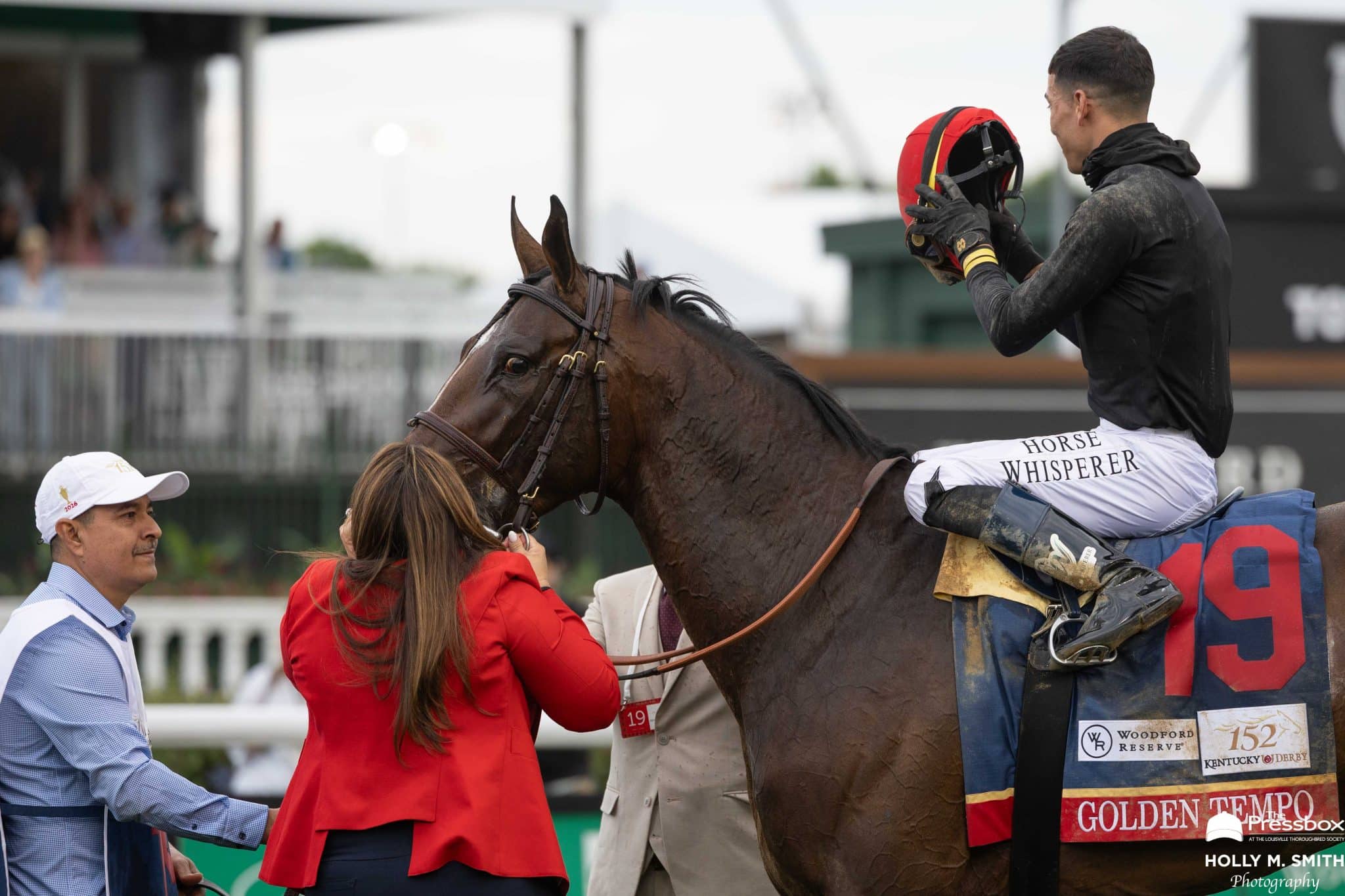

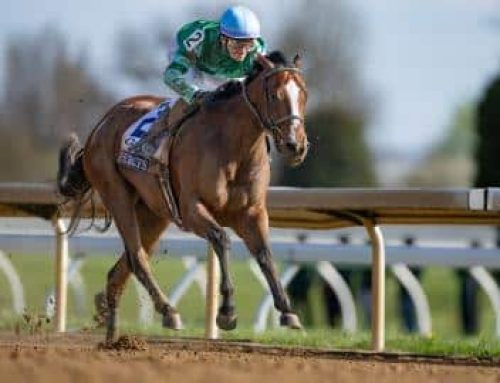
(Trainer Cherrie DeVaux gives Golden Tempo a kiss after winning the 152nd Kentucky Derby / Photos by Holly M. Smith)
From the Churchill Downs Media Team / Darren Rogers:
KENTUCKY DERBY WINNERS POST RACE NEWS CONFERENCE TRANSCRIPT
JIM MULVIHILL: All right, everyone. Welcome down to the media briefing room. We have a jubilant bunch here: The winners of Kentucky Derby 152, the connections of Golden Tempo. Congratulations to you all. From left to right ‑‑ (applause) ‑‑ Ogden Phipps, Daisy Phipps Pulito, Cherie DeVaux, Jose Ortiz, Teresa and Vinnie Viola. Congratulations to all of you.
Cherie, how are you feeling?
CHERIE DEVAUX: I’m not sure. (laughter)
I am so overwhelmed right now. I’m so proud, so proud of Golden Tempo. Really proud of Jose Ortiz. I’m so grateful to Vinnie and Teresa Viola, St. Elias, and Daisy and Ogden at Phipps Stables.
JIM MULVIHILL: Cherie, can we walk through the race together. Can you tell me, first of all, what’s in your mind, say, approaching the first turn. You’re 15 to 20 lengths behind. But he’s settling in well. What are you thinking at that point?
CHERIE DEVAUX: That’s how he runs, so it’s not like we really did anything different than he hadn’t done in his previous starts.
There was a lot of speed on tap, on paper, and that materialized. And I watch Jose [Ortiz] come up and get himself in position going into the final turn.
And about the 3/16 pole, I thought we’re probably going to win this. And then, I really kind of blacked out after that. (laughter)
JIM MULVIHILL: Tell us what you do remember. We saw on the NBC feed you going crazy with your entourage. What were you saying? What was going through your mind?
CHERIE DEVAUX: I was just ‑‑ I couldn’t believe it. None of us really can believe it. There was a joke that I’m going to be a one‑and‑done, but now I think I’m going to have to do this again. (applause)
JIM MULVIHILL: Jose, capping off an incredible weekend for you. Can you take us through the trip?
JOSE ORTIZ: Yeah, I knew my horse was a deep closer, so I don’t have any interest in being in front early. You can see the way I broke, when I go to the rail and save ground.
So I did that, and I was hoping for a big run late. I was hoping for a fast pace, and I’m glad we had it.
JIM MULVIHILL: Do you feel coming into the stretch like you still had a lot of horse? You had a chance to go inside but you went around, so it looked like you knew you had horse.
JOSE ORTIZ: I win them every day inside with a 20‑horse field. I’ve done it in the past. Not good.
I felt like I had horse. So I was following Irad [Ortiz Jr.] on Renegade, and I felt like we were moving along very nice. I felt like going outside on him wasn’t going to hurt me. I think he was the horse to beat.
So I’m just ‑‑ I’m just very happy we won the race.
JIM MULVIHILL: Cherie, Daisy said a few moments ago she was quietly confident coming into the race after the works at Keeneland. Can you talk about your mindset coming into the race with what on paper was a long shot, but it seemed like your group felt pretty good.
CHERIE DEVAUX: Well, we had a plan, even right after the Lecomte when he won. We talked that he’s a horse that’s going to continue to develop and mature. And the goal was not to win those races; the goal was to win this race.
So each race was a building point to get here. And we had an idea ‑‑ I had an idea and our team ‑‑ I’m so grateful to our team and to Jose [Ortiz] because Jose came out and worked him for us.
You know, we had the plan going six weeks from the Louisiana Derby into the Kentucky Derby, and I had an idea of how we wanted to get there.
And it’s hard. I can have all the ideas in the world, but if my staff and my team can’t enact it, it’s just not. So I’m just so grateful and I’m so blessed for everyone on our team and to Jose.
JIM MULVIHILL: Cherie, you know that a lot of the stories are going to lead with the fact that you are the first woman to train a Kentucky Derby winner. What’s your reaction to that?
CHERIE DEVAUX: I’m just glad I don’t have to answer that question anymore. (Applause)
JIM MULVIHILL: Daisy, I’d like to come to you. You run what is an iconic, very influential stable. What does this mean to the Phipps Stable to win the Kentucky Derby?
DAISY PHIPPS PULITO: This is everything to anybody in horse racing, really. This is what we breed to race. This is why you do it, to be on stages like this. And the way he ran and the way he was raised at Claiborne Farm.
There’s just so many people to thank in this: Claiborne; Barry Eisaman, who broke him; Jose, his groom; Enrique who is his exercise rider. Obviously, Cherie who runs that team. It’s just been an unbelievable group effort. He’s been a pleasure to be around. It’s been a really fun campaign.
JIM MULVIHILL: Vinnie, a few moments ago when you saw Daisy, you said “a homebred.” What does it mean that this is a homebred? It’s enough to win the Derby, but to do it with a homebred.
VINCENT VIOLA: It’s very special, because a bunch of thought went into that breeding going back to it. I got to give John Sparkman a huge acknowledgment here. He was very, very certain about Curlin with that mare. And it feels really special.
JIM MULVIHILL: Cherie, tell us more about the progression over the past few months in New Orleans and how you got to this point today, having won the Kentucky Derby.
CHERIE DEVAUX: Training Golden Tempo has really been a treat. There’s not a lot of times when a colt that is as big as he is, is as pleasurable as he is. I mean, he is such a consummate professional.
He’s got a wonderful personality. So really, he allowed us to train him, and he responded to what we asked him to do throughout each process.
He improved each race. We trained him a bit hard in between, and he showed up for us every time. He’s done everything we’ve asked of him, and obviously, winning the Kentucky Derby.
JIM MULVIHILL: Jose, winning the Oaks and the Derby in the same weekend, not too bad.
JOSE ORTIZ: Not at all.
JIM MULVIHILL: And your first Derby.
JOSE ORTIZ: Yep. (Cheers and applause)
JIM MULVIHILL: How does it feel?
JOSE ORTIZ: It feels great. Unbelievable weekend. It’s the result of all the hard work I put in for the last 15 years. I’m just very happy I get to win this race. And I’m very happy for Vinnie [Viola], Teresa [Viola], Cherie [DeVaux], Daisy [Phipps], Danny [Sparkman], all the team back in the barn. They work so hard with these horses. It takes a lot of people to win a race like this.
I just want to be thankful. I feel blessed to be here. I’m just very thankful to all of them.
CHERIE DEVAUX: May I say something?
JIM MULVIHILL: By all means. You can say whatever you want, Cherie. You just won the Kentucky Derby.
CHERIE DEVAUX: I just, I want to commend ‑‑ I have known Jose [Ortiz] since he was a kid; him and Irad since they were babies. And it’s been such a pleasure to watch. They’re both extraordinary human beings. They are hard workers. And I watched Jose develop, and we’ve done a lot together. But just to know him from the very beginning to now, it’s a complete honor and I’m so proud of you. (Applause)
JIM MULVIHILL: Cherie, Jose [Ortiz] was on him all winter in New Orleans. Were you worried you would be able to keep him for this race when you got here?
CHERIE DEVAUX: I did reach out to Steve Rushing, his agent. And I said, please, please put my mind to rest, you are going to ride my horse, right?
And when Jose decided to come to Kentucky, they really put all in on us. Jose, as soon as he made that career change and moved, we’ve done unbelievable things. We’ve won our first Breeders’ Cup.
So, yes, I did ask apprehensively, when I knew there was going to be a couple moving around. But just so, so thankful that it worked out for us.
JIM MULVIHILL: Congrats to Steve Rushing. What a weekend.
VINCENT VIOLA: I want to make sure we thank the head of our racing operations, Monique Delk. Teresa and I asked her to basically move down to Louisville. You have been here for about three weeks, Monique? (Applause)
She’s really the heart and soul of our operation. Thank you.
JIM MULVIHILL: Jose, have you had a chance to process being in a stretch duel with your brother for the Kentucky Derby? And what was the interaction after the wire?
JOSE ORTIZ: I felt like he wasn’t a closer on Renegade. I led him in a comfortable position, so I knew he was going to drop a little bit to the back. But I also knew he’s a very nice horse. So I was expecting him to run a very good race, maybe win it. So it was one of my targets to follow. And I did.
Yeah, I wasn’t expecting it, but I was, like, I could see it happening. But I didn’t know he was going to be second, you know? It’s cool for him, he run second. Like I say before, hopefully he get the opportunity to win it one day.
CHERIE DEVAUX: Today is not that day.
JOSE ORTIZ: It wasn’t today. (Laughter)
- Daisy and Vinnie, when did you start sending horses to Cherie? And what did you notice about her that made you want to send her horses?
DAISY PHIPPS PULITO: Was it two years ago? Last year and this year.
CHERIE DEVAUX: Yes.
DAISY PHIPPS PULITO: We sent her three or four horses. And she’s done a conflict job. Cherie and I have known each other for a number of years. Her husband is a good friend of mine also. I have been watching the way she trains. She’s in Kentucky. I live in Kentucky. and I love the way she works with horses. I love the way she develops a horse.
And Monique and I had those talks about different horses we wanted to send to her. And we thought Golden Tempo would be a great match, and it was.
- I have a question for each set of owners, one for the Phipps’. 13 years ago, you all won the Derby with Orb and with Stuart Janney. Talk about just carrying on, how important it is to carry on the family legacy with another Derby winner. My question for the Violas is how this compares with the Stanley Cup championship, which would be very hard to breed a champion Stanley Cup team, I’m thinking.
OGDEN PHIPPS: I can’t talk about a Stanley Cup. I was rooting very hard for the Panthers last year. That was an incredible run the Violas had.
For our family, this is something we have done together for many generations. As you look in the back here, I have five sisters and all of my sisters are here, and my nieces and nephews are here, my three kids are here. And I’m not sure I have ever seen them so excited as today.
My kids and my nieces and nephews weren’t able to be here for Orb, but everybody is here today. We always maybe thought what this feeling would be like to be together and do it. It far surpasses it.
The one person that is not here today, that I just want to recognize, is our mother, who’s back at home watching. We all got a chance to talk to her right after the race. We were here, obviously, with my dad 13 years ago, and really because of the two of them, we have kept this going. Very thankful we did.
It was never an option not to. This is in our blood and we love it. When we were looking for partners, the Violas and our family are very, very close. It was just a natural to try to do this together. And just super thankful that we have.
It’s a family hobby. It’s a family passion. It’s a family business for us. And we love it.
JIM MULVIHILL: How does it compare to winning a Stanley Cup?
VINCENT VIOLA: I’ll let Teresa answer.
TERESA VIOLA: I can’t on that one. (Laughter)
VINCENT VIOLA: Two very, but fantastic nonetheless, feelings.
- Kind of a two‑parter here. When you first went on your own, 11 months it took to get to that first win. During that stretch, could you ever have imagined ‑‑ or is this what kind of kept you going, just the dream of having a win like this? And also wanted to see what do you think Chuck Simon would tell you if he was here today?
CHERIE DEVAUX: I’m one of those thick‑minded people that thinks it’s always going to work out. So, you know, it took a while. And, again, I have to say an immense amount of gratitude to my husband who has stuck behind me. He just told me just give it three years. Let’s just give it three years and see if it works out, and I could always go and do something else.
I didn’t believe ‑‑ I started my career here 22 years ago as a bright‑eyed, bushy‑tailed exercise rider. And I would not believe that I would be sitting up here today. Never in my life did I think I would.
And Chuck [Simon], he would be so proud. I am here because of him. Because he pushed me. He pushed my boundaries. He gave me direction when I needed it. And he was always proud of me. But I just think this definitely would have put him over the top. And I can’t wait to drop one of these off at our old barn here. Can’t wait to do that. (Applause)
- Cherie, to me it seems that you guys ran kind of pressure‑free. Assuming that’s the case, how did that contribute to the preparation for the race?
CHERIE DEVAUX: I don’t know if you can come to the Kentucky Derby with any contender and think it’s pressure‑free. I tried ‑‑ a lot of pressure was put on before we got here in the preparations. Usually when you get here, it’s a wonderful week. Just try to get through, try to get some sleep ‑‑ (laughter) ‑‑ but we just try to enjoy ourselves.
I don’t know. I kind of just had this feeling that he could do it. And if I could manifest it, as the kids say, it would have been just what happened. I mean, the same trip, everything.
- Will you run in the Preakness?
CHERIE DEVAUX: And we’re going to let him decide that. We’re going to see how he looks tomorrow, and subsequently, the next couple weeks ‑‑ or, you know, the next couple days. But we’re going to have to allow him to tell us, because the horse is first. We’re not here for ourselves. We’re not here for our egos. We’re here for the horse. (Applause)
- It’s not something that’s off the table, like last year pretty much Bill was thinking ‑‑
CHERIE DEVAUX: No. I think we all just want to let today set in, and then we’ll worry about tomorrow tomorrow.
- Jose, the situation with Great White prompting the track officials to remove the horses from the gate, did that have any effect? Or did you notice anything maybe at the start? Did it affect any of the other horses or your horse, in particular?
JOSE ORTIZ: I don’t know. Obviously, when you load into the gate, you don’t want to back up. So I wasn’t in there yet, so I was very happy. My guy wanted to put me in. No, no, no, he’s going to be scratched, don’t put me in.
- Do you think that helped that you weren’t in the gate yet?
JOSE ORTIZ: I don’t know. It’s very hard to tell you. It’s like if I tell you if I’m going to win tomorrow, I don’t know.
I mean, as I tell you, I didn’t want to be loaded and back off. I would hate that. I think the horse is ready. His mind is ready to go. When you put him in, he knows he’s going forward. As soon as you back him up, then everything changes.
So if it affect one of them, it’s very hard to tell. Seems like a pretty clean break.
JIM MULVIHILL: Can you tell us more about the patience it takes to ride a closer and how you knew when to start moving?
JOSE ORTIZ: I don’t know. It’s ability you have. I have been riding here, and I know the track better. And I know the point that I had to make my move today. I think I timed it right.
JIM MULVIHILL: I would say so.
- Jose, you are one of the top riders in the country. You can almost pick and choose. What was it about Golden Tempo that told you he was the one, that he needed to be your Derby horse?
JOSE ORTIZ: Loyalty with Cherie. Working with her all winter at Fair Grounds. We always knew we sort of have a lot of ability. But he’s very lazy, as you know. You can see early in the race, we tried blinkers to see if that would change. It didn’t help much.
But yeah, she has been very loyal to me, so I feel like I should give that back. And I knew always Golden Tempo was going to be my mount.
- You said you are glad you don’t have to answer the question, but can you talk about the significance of what you did today? You will go down in history.
CHERIE DEVAUX: Again, we worried about today, and worry about tomorrow, tomorrow.
Being a woman or my gender has never really crossed my mind in this journey of mine. I have to say, the racetrack is a tough place. It’s a tough place if you are a man. It’s a tough place if you’re a woman.
The thing that really has become apparent to me is that not everyone has the same constitution as I have mentally. It really is an honor to be able to be that person for other woman or other little girls to look up to. You can dream big, and you can pivot. You can come from one place and make yourself a part of history.
JIM MULVIHILL: Can you summarize for us real quick how many horses do you have in training, and where all do you go?
CHERIE DEVAUX: We are Kentucky‑based. We top out about 120. The 2‑year‑olds are getting ready to come in. We have a couple loads. So by design, we keep that number ‑‑ that’s our top number. So end of the winter, we start to consolidate or move horses along. A lot of fillies get bred, and some go become my barn pony, a couple of those. And now we rebuild.
So right now, we’re at Churchill. Keeneland is our home base. And we have had a handful at Turfway and we are going to get ready of the 2‑year‑olds at Ellis Park. So we will close Turfway. It’s really important to me that I keep my numbers where we are. I keep my divisions manageable. I’m a hands‑on trainer. It’s important to me I really stick to those core values of my business.
- I’m with Fanduel until June 26th.
DAISY PHIPPS PULITO: We’re going to miss all of you guys.
- Jose, you were red hot this weekend. What’s the mindset? So much pressure in the Derby. But what’s the confidence level like for you? What, did you win four yesterday?
JOSE ORTIZ: Five.
- Sorry, cheated you out a race. Five and the Oaks. That obviously has to help going into a race like this, especially with a closer, with timing meaning so much. With your confidence level being sky high, did yesterday have any sort of impact on today in terms of your preparation and your ride?
JOSE ORTIZ: I think so. When you are riding in the zone, it’s very good. It seems like you make every right move. You move at the right time. I’m glad I had that this weekend. Some other times, every move you make is wrong.
But, no, I feel like ‑‑ I’m 32. I’m hitting kind of prime for a jockey. I think I got experience. I’m young still, but I’m very experienced. Yeah, I think those two combined. I’m calm. I trust my horses.
The part of remaining calm is to have the confidence for the trainers I ride for, who believe in me, trust me, trust my judgment, and let me ride the horses the way I want to ride my horses. As soon as I step out of the gate, I want to be in charge making the decisions because. To be honest, most of the time, the ride don’t go the way you plan it. It’s very rarely.
And to have free rein to trust myself, my instincts is very important. I’m riding for a great group of trainers right now, that they allow me to be me and to be myself. I think that helps a lot, that you can make a move and they won’t be mad at you. They also got your back. So I think that helps a lot.
JIM MULVIHILL: Cherie, in your bios, it always notes that you went to college to study premed. How did that transition go, where you decided not to do the premed and to go to the racetrack? One other thing, I started following your family yesterday on Twitter, on this van ride down to Kentucky. What do you think that van ride is going to be like on the way back? (Laughter)
CHERIE DEVAUX: Okay, collect myself here.
So my path here is kind of an interesting one. My family is involved in harness racing. They took a sabbatical and moved to Florida. And they were trying to leave, and I said I’m staying. So I finished my first year and then they left back to New York.
And it was really the fact that I had to switch gears, because I was losing my in‑state residency. And when I went to New York, I really want to thank them for not counting a whole year’s worth of general education credits and then adding another 16, so it was a full year.
But that also allowed me to ‑‑ I was never introduced to thoroughbred racing. I needed a job, and my mother says, well, there’s a barn across and all you have to do is walk the horses. And that’s how I started.
And then I thought “I can ride them.” I had this advisor my last year, and she was telling me I had to take organic chemistry, which no premed student wants to take. I just looked at her and said: No, I’m going to go work on the racetrack. She’s like: Are you sure? I was like, I’m just going to see how it works.
That’s when I met Chuck [Simon], and Chuck’s first job was for my father at the harness track. I was a wild child. When I tell everyone you can make mistakes, you can do whatever, but Chuck saw I going the wrong way and took me under his wing and made me be an assistant trainer, begrudgingly, because I was really enjoying the party life. But he kind of wrangled me in.
So, you know, it was just one of those things where things just happened to work out.
I didn’t want to be a horse trainer, and it just kind of evolved into that. I’m sorry, what was the second part of your question before I went off on a tangent? Oh, the van ride, yes.
They’re probably not going to sleep, so they’re leaving tomorrow. They were supposed to go to the Keeneland Track Kitchen and then leave. So I don’t know if there’s enough Red Bull or any energy drinks in the world for them. But they’re probably riding high.
- Cherie, earlier in the week you had to lighten up on the horse’s training. I don’t know if you have watched this replay, but he’s dead last at the 3/8 pole, has to past 17 horses. Was there any point that you thought this is going to catch up to me? And why were you so confident that he was going to get there?
CHERIE DEVAUX: So, yeah, we lightened up on his training. It’s kind of one of those things where you want to be honest and transparent but not everybody understands what that means.
So, I mean, horses, giving them two jog days won’t change the outcome of that race, even if we lost by a nose. He’s a horse. He is what he is. He’s a dead‑closer. And the thing that ‑‑ the Louisiana Derby really solidified that he was getting there from the 1/8 pole home. If he had a little bit extra ground, he was going to make it.
It was just one of those things where you just have to have in the process, faith in the horse, and faith in Jose [Ortiz].
“Got to have faith,” there’s a song.
- This board is so much about history. I was hoping you could speak to the fact that your family can trace their roots back a whole century when the stable was founded in 1926.
Can you speak to the staying power of your family in a sport that’s so steeped on tradition, considering you can trace it back 100 years when the stable was originally founded?
OGDEN PHIPPS: We talked about breeding a little bit earlier.
The fact that my great grandmother and grandfather and dad, they really invested in and cared for their great fillies. That gave us an incredible base to always be continuing to grow from. And we would call them foundation mares. And I think we’ve been fortunate enough to have a bunch of them. And obviously, Carrumba has certainly become one now. And she also gave us some great thrills as a racehorse as well.
But I think the fact that we kept our broodmare band intact and continued to invest along the way, and obviously, partnering with the Violas where they allowed us to continue to breed to the great stallions out there, Curlin in this instance. That’s how we have been able to keep doing it and taking care of our girls.
JIM MULVIHILL: You two recognized that maybe some things needed to change in the operation for modern‑day racing. Can you talk about how that leads to a day like today, and perhaps what changes you’ve made in the last ten years or so?
DAISY PHIPPS PULITO: In the last ten years, I think we made several changes. We don’t have as big of a broodmare band as when my grandfather was alive or when my father was alive. My grandfather probably had 40 broodmares. We keep between 16 and 20 now.
And we brought in partners, and we’ve sold more horses at auction than we have ever in the past. And that’s to breed better stallions and get better fillies at the end of the day.
JIM MULVIHILL: What time can we come see the Derby winner tomorrow morning? Can you bring them out of the barn for us?
DAISY PHIPPS PULITO: Why are you looking at me? You’re the trainer. (Laughter)
CHERIE DEVAUX: Let’s say 9:00. Is that a good time? 9:00? We’ll say 7:30. There you go.
- Up there in the Winner’s Circle, being able to celebrate with your family, was that your son throwing the rose petals and holding the trophy with you? What was it like to share that moment with them?
JOSE ORTIZ: My oldest son, Derek, with the roses. Nikolai had some as well. They both had them at some point.
Yeah, it was a beautiful moment to share with them. My wife, she come from a racing family as well, and she rode. So she probably know how big the moment is, and I’m very happy to share this with her and my three kids.
VINCENT VIOLA: It’s not lost on Teresa and I, the whole family, that the Phipps family have allowed us to participate in this sport with them. So Ogden and Daisy and the whole family that’s here, it’s not lost on us. And we deeply, deeply appreciate the opportunity to do special things like this.
Jose, I remember the first day I met you and Irad [Ortiz]. It’s just been a very special friendship and relationship, and the trust is just, it’s always been there. And I can’t tell you how much it means to me that I’m sitting next to you on your first Derby.
And Cherie, I watched you train. Daisy [Phipps], myself, Monique [Delk], Ogden [Phipps], we just can’t tell you how proud for you we are. So let’s get a couple more, huh? (Applause)
CHERIE DEVAUX: I told you, I’m a one‑and‑done kind of girl. Just kidding! Thank you. Thank you. I’m so appreciative of the opportunity. Yeah, it’s been amazing. And again, I’ve known both the Phipps and the Violas, and we have had a special friendship and camaraderie. It’s special to share this.
Leave A Comment
You must be logged in to post a comment.